

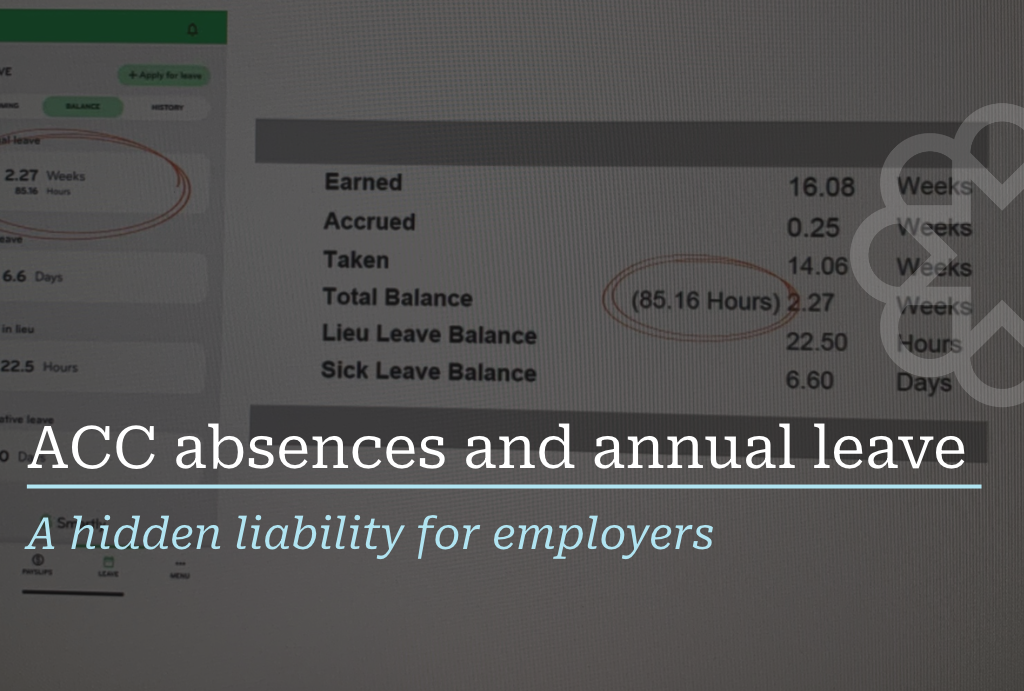
Most employers know that employees on ACC remain employed while they are receiving weekly compensation.
What is less well known is that annual leave generally continues to accrue during that time.
An employee may be away from work and receiving ACC weekly compensation, but that does not necessarily stop their annual leave entitlement from building up.
Under the current Holidays Act 2003, employees on long-term ACC generally continue to accrue annual leave while their employment remains ongoing.
The eventual cost can be significant, as the Employment Relations Authority’s decision in Blissett v Absolute Scaffolding (2019) Ltd [2023] NZERA 310 demonstrates.
The summary
Mr Blissett worked for Absolute Scaffolding for only a short time (about two weeks) before shoulder injuries prevented him from continuing to work. He remained employed while receiving ACC compensation and was eventually dismissed for medical incapacity in July 2021. Although the Authority found that his dismissal was justified, it upheld his claim for unpaid holiday pay.
Absolute Scaffolding had paid Mr Blissett just $33.70 in holiday pay. The Authority found the correct amount was $4,391.30.
Why was the holiday pay so much higher?
When employment ends, the Holidays Act requires outstanding annual holidays to be paid at the greater of the employee’s:
- ordinary weekly pay; or
- average weekly earnings.
An employee’s average weekly earnings may be very low following a lengthy ACC absence because ACC weekly compensation is not treated as gross earnings paid by the employer.
However, that is not necessarily the end of the calculation.
In Mr Blissett’s case, the Authority determined his holiday pay by reference to his agreed hours and rate of pay. Absolute Scaffolding was ordered to pay him four weeks’ annual holiday pay, together with 8% of his gross earnings for the period following his last annual leave anniversary.
The case shows that an employee’s annual leave may retain considerable value even where they have earned little or nothing from their employer during an extended ACC absence.
What employers should take from this
Employers should not assume that accrued annual leave will have little or no value simply because an employee has been away from work for a long period.
If an employee remains employed while receiving ACC compensation:
- their annual leave liability may continue to grow;
- their contractual hours and remuneration may still be relevant to the value of that leave;
- relying solely on average weekly earnings may produce the wrong result; and
- delaying a medical incapacity process may increase the employer’s eventual holiday pay liability.
Long-term ACC absences should therefore be actively monitored.
Where an employee’s return to work remains uncertain, employers should regularly review the situation and consider whether it is appropriate to begin a fair medical incapacity process.
Looking ahead
The position will change when the Employment Leave Act 2026 replaces the Holidays Act on 6 August 2028. Until then, employers must continue applying the existing Holidays Act rules.
Under the new framework, annual leave will accrue in hours by reference to an employee’s standard hours. The new Act also identifies circumstances in which annual leave will not accrue, which will reduce the risk of leave continuing to accumulate during lengthy periods when an employee is receiving ACC compensation.
Need support? If you would like assistance with any matter relating to ACC, leave or any other workplace matter please get in touch with our team. Email admin@cmalaw.co.nz or phone 03 211 0153.
Disclaimer: This update provides commentary on employment law, health and safety and immigration topics, it should not be used as a substitute for legal or professional advice for specific situations. Please seek legal advice from your lawyer for any questions specific to your workplace.