

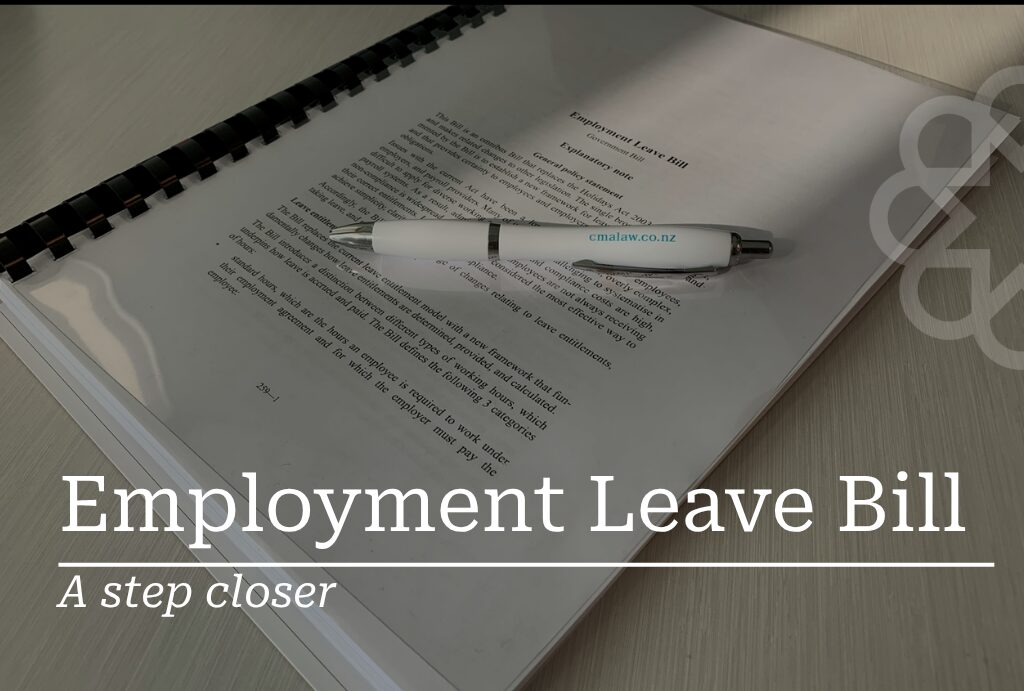
On 29 July 2026, the Employment Leave Bill 2026 (Bill) passed its third and final reading and is awaiting Royal Assent before becoming law. Once enacted, a 24 month transition period will apply before the new regime takes effect.
Earlier this year, we summarised key changes Parliament was proposing to make to the Holidays Act 2003 (Holidays Act).
Since then, the Education and Workforce Committee examined the Bill and recommended a number of refinements. You can read the Committee’s report here.
Here are some key takeaways:
- The Bill has passed its third reading and is now awaiting Royal Assent before it becomes law.
- Parliament has largely retained the core features of the Bill, including the shift to an hours-based leave system.
- Amendments recommended by the Education and Workforce Committee were incorporated to improve clarity, fairness and practical operation of the legislation.
- Employers and payroll providers will have a two year transition period to prepare for the new framework.
A reminder about key reforms
The Bill will repeal and replace the Holidays Act. Key features include:
- A new framework that distinguishes between standard, additional and casual hours.
- Annual leave and sick leave accruing in hours from the first day of employment against standard hours.
- A single hourly rate methodology for paying leave.
- A 12.5% leave compensation payment for additional and casual hours, rather than accruing annual and sick leave on those hours.
- Bereavement leave and family violence leave being available from the first day of employment.
- A new “otherwise working day” test for determining public holiday entitlements.
- Greater flexibility around annual leave cash-ups and enhanced transparency through mandatory pay statements.
| Standard hours – making notional rosters better reflect actual work patterns | The Bill introduces the concept of standard hours and notional rosters. Standard hours are the hours an employee could be required to work and must be paid for under their employment agreement (but excludes any hours under an availability provision). Standard hours must be specified in the employment agreement, work roster or the employee’s notional roster. A notional roster is an agreed hypothetical work pattern that records the days and hours an employee would normally be expected to work. The employer and employee would be required to agree to a notional roster if the employee’s standard hours were not sufficiently detailed in the employment agreement. The roster could then be referred to by the employer to help determine leave entitlements. Concerns were raised about notional rosters not matching actual work patterns. To avoid unfair outcomes, the Committee emphasised that notional rosters needed to be an accurate reflection of an employee’s pattern of standard hours. The Committee also recommended including an alternative approach to determine standard hours by agreement. |
| Standard hours – allow flexibility where employees have multiple roles with the same employer | The Bill looks to create a framework for managing entitlements where an employee performs more than one role for the same employer. This would result in an employee holding separate leave balances for different roles. The Committee has recommended creating more flexibility for employees and employers to agree to arrangements that best suit their circumstances. If the parties could not agree, then the default position would apply. |
| Clarification of annual leave obligations | The Committee sought to strengthen and clarify provisions relating to annual leave. Employers would: Need to make reasonable efforts to agree when annual leave would be taken. Not be able to unreasonably withhold consent. Not be able to require employees to work additional hours while they were on annual leave, without agreement. |
| Refinements to other leave entitlements | The report includes additional refinements to provisions relating to public holiday, bereavement, family violence and sick leave entitlements. These changes are largely intended to improve drafting and operational clarity. The Committee has also amended provisions dealing with the transfer of leave entitlements as a result of a restructure. |
| Clarification to the “otherwise working day” test | Our previous article outlined the proposed test for determining whether a public holiday falls on an employee’s “otherwise working day” (OWD). The Committee agreed that there was a gap in the OWD framework introduced by the Bill. It has recommended updating the test to include workers who have some specified workdays, but who also regularly work additional days. Those additional days can now be taken into account when determining entitlement to public holidays. This amendment aims to ensure employees with variable schedules are less likely to miss out on entitlements simply because working arrangements do not fit neatly within a standard pattern. |
| Changes to remediation and transition arrangements | Remediation and transition arrangements are intended to ensure a smooth transition to the new regime. The Committee has recommended changes to improve the framework for addressing non-compliance with the Holidays Act. |
What does this mean for employers?
The Bill represents the most significant reform of New Zealand’s leave and holiday framework in more than 20 years. Although the Bill is awaiting Royal Assent, it is only a matter of time before the Bill becomes law.
Employers should begin considering the practical implications now, including:
- payroll system updates;
- leave tracking and administration processes;
- employment agreement reviews;
- workforce planning and rostering arrangements; and
- transition and compliance planning.
The two year implementation period is intended to give employers and payroll providers sufficient time to prepare, but the scale of the changes means early planning will be important.
Need support? If you would like assistance with anything relating to leave, the Holidays Act, or the new Employment Leave Bill, please get in touch with our team. Email admin@cmalaw.co.nz or phone 03 211 0153.
Disclaimer: This update provides commentary on employment law, health and safety and immigration topics. It should not be used as a substitute for legal or professional advice for specific situations. Please seek legal advice from your lawyer for any questions specific to your workplace.